
• Skip to primary navigation
  • Skip to main content
  • Skip to primary sidebar
SimplifyEm Property Management Software Logo

510-790-9066
510-790-9066
》Sign In
  • Features
    • Accounting Software
    • Reconciliation
    • Tenant Screening
    • 1099 E-filing
    • Reports
    • Communication Center
    • Integrated Rental Application
    • Rental Listing
    • Online Rent Payments
    • Tenant Portal
    • AI in Property Management
  • Property Management
    • Online Rent Payments
    • Tenant Screening
    • Rental Listings
    • SimplifyEm CRM
    • FAQ
  • Rental Forms
    • Lease Agreement
    • Rental Application
    • Notice to Vacate
    • Notice to Quit
    • Lease Termination
    • Notice to Pay Rent
    • Rental Inspection
    • Eviction Notice
  • Pricing
  • Reviews
  • Schedule Demo
  • FREE TRIAL!
  • 》​Sign​ In

Rental Laws & Taxes

Are ADU (Additional Dwelling Unit) Rentals a Good Idea?

Filed Under: Business Management, Property Maintenance, Property Management, Property Management Software, Real Estate Investing, Rental Laws & Taxes

What is an ADU?

An ADU (Additional Dwelling Unit) is a secondary/independent living unit on the same land as a primary residence unit. ADU’s can be attached to a primary residence or detached. It would most likely consist of a kitchen, living area, bathroom and separate room or space for bed.

It’s typically smaller in size and suitable for either a single person or a couple.

Many cities are encouraging developing ADU’s due to a shortage of housing and also rentable units compared to demand for affordable housing.

Government data from the Federal Housing Finance Agency and California Department of Housing and Community Development shows ADU’s are becoming popular.

The number of ADU are growing. Here is data for California:
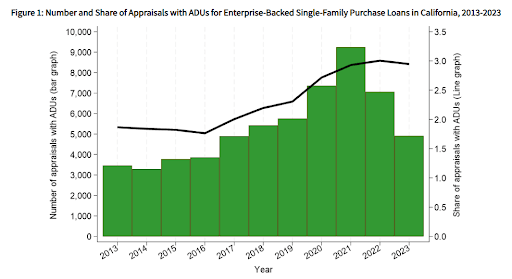
Growth in Number of ADU Per Year

You can also see the value of properties with ADU is also growing, here is data for California:
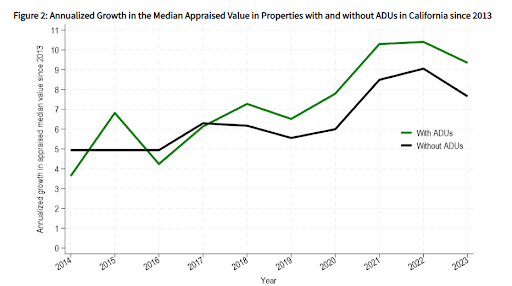
Property Value Growth with an ADU on the property.

What Steps Are Required to Create an ADU?

If you want to create an ADU, you should take into consideration the following:

Cost – What kind of funding/loan will you need?
Type of ADU – What type of ADU are you building?
Local Regulation – What type of regulations does your local municipality require?
Design the ADU – Find an architect or designer to create plans.
Permits – Get necessary permits from your local planning authority.
Contractor – you’ll need to hire a licensed contractor, unless you’ll build yourself.
Construct – Get it built and inspected by municipality inspectors.

Cost of ADU

Building an ADU is a significant expense. You should have a good idea of cost before you start. Here are some estimates based on size. The range is determined based on your location and design choices.
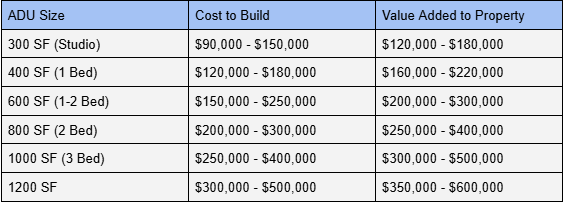
Cost and Value of ADU based on size

Type of ADU

There are a variety of types of ADU; you should determine if you can use space in the primary residence to convert it to an ADU or if you have enough space in your lot to construct one.

Here are some of the common types to consider:

  • Detached ADU
  • Attached – addition to main house
  • Garage converted to ADU
  • Basement converted to ADU

Local Regulations Governing ADU’s

You’ll need to contact your local planning authority to understand ADU rules. Some things to consider are:

  • Zoning Laws – Can you build an ADU in your neighborhood?
  • Size limits – What’s the maximum size for an ADU?
  • Setbacks – How much space do you need from your neighbors to where you can place an ADU?
  • Height Restrictions – How high can roofline and ceilings be?
  • Parking – What kind of parking if any do you have to provide?
  • Occupancy – Are there limits to the number of people allowed in ADU? Can it be used for long and short term rental?

Designing the ADU

You will need to find an Architect or Designer you’re comfortable with to come up with plans that meet your cost requirements and also satisfy local regulations.

Permits for an ADU

You and your Architect should set up a meeting with your local planning department to determine what kind of permits you need to start the project.

Typically, you’ll need:

  • Building permit
  • Zoning Approval
  • Site plan approval
  • Utility permits
  • Fire safety compliance

Getting a Contractor to Start Building your ADU

Once you’ve gotten the appropriate permits, you need to start construction. There are two key decisions you need to make. First, will you build yourself or use a contractor? Second, if you use a contractor finding the right one for you.

Make sure your contractor has an up-to-date license.

Constructing an ADU

Once you have started construction, at the end of each stage of the build, get it inspected for approval by the planning department. Typically, different stages where you’ll need an inspection are:

  • Foundation
  • Framing
  • Plumbing
  • Electrical
  • Final Inspection

Inspectors are your friend; getting it approved by them can ensure you’re getting quality work.

Should I Create an ADU from Scratch or Prefab?

One other consideration that can affect costs is should build ADU from scratch or prefab?

Typically, custom construction takes longer and is more expensive. However, you can customize the design to your liking so it better matches the main residence. It also tends to have higher resale value.

Whereas prefab is limited in design, which can make it look more cookie-cutter. It can also have a lower resale value. However, construction can be done faster, and it can also lower costs. Sometimes it’s easier to get a permit as well.

What Are the Costs and Benefits of an ADU?

An ADU can be a great investment. The costs are significant based on the size, location and design choices, as we showed earlier.

There are many benefits, such as:

  • Rental income
  • Property value increase
  • Flexible space for family needs: aging parents, adult children, guest space
  • Affordable housing – Help your community by providing affordable housing.

Should You Consider Section 8 Housing for your ADU?

Section 8 housing means you’re willing to accept low-income tenants where a portion of the rent is paid by the government. There are many advantages and disadvantages to consider.

Advantage:

  • Guaranteed rent payments
  • Larger pool of potential tenants
  • Lessens the risk of rental loss

Disadvantage:

  • Property inspection to meet Section 8 standards
  • Rent must comply with government regulations
  • More government administrative work

Do You Want To Accept Pets in ADU – Is It Pet-Friendly?

Accepting pets in your ADU has many advantages and disadvantages.

Advantage:

  • Larger pool of potential tenants
  • Higher Rent (Pet Fee, Pet Rent)
  • Tenants tend to stay longer

Disadvantage:

  • More property damage
  • Noise issues
  • More cleaning when tenants move out

Should You Make Your ADU a Short-Term Rental?

It can be profitable to have your ADU as a short-term rental (AirBNB) rather than long-term rental. There are many advantages and disadvantages.

Advantages

  • More rental income
  • Flexibility for your own usage of ADU
  • Tenant turnover is easier

Disadvantages

  • Zoning restrictions – Many cities do not allow it.
  • More management – since there is frequent tenant turnover
  • Operating cost – frequent cleaning, furniture, Utilities

How can SimplifyEm help with your ADU?

If you are renting out your ADU. You need software that does an excellent job of:

  • Keeping track of your tenants account and balance
  • Great communication capabilities to stay in touch with your tenant and have everything recorded.
  • Having your records ready for tax time.

SimplifyEm Property Management Software does all of this and is the easiest to use.

Frequently Asked Questions (FAQs) about ADU

  • What is an ADU?

    ADU (Additional Dwelling Unit) is a secondary living space in the lot of a primary residence.

    It can be a detached space or attached (such as a converted garage or basement) as an independent unit consisting of a kitchen, living area with a bedroom space, and bathroom.

  • What are the costs and benefits of an ADU?

    The cost of an ADU consists of permit to build as well construction cost. The factors that affect its cost are size of space, design decisions you make, as well location. It can be very expensive to construct running into several hundred of thousands dollars.

    It provides many benefits and gives you a flexible space to deal with elderly parents, adult children, as well as guests.

    You can also rent it out for income. Having an ADU on a property typically increases property value.

  • Should I consider a Prefab ADU?

    A Prefab ADU is absolutely worth considering. It provides many benefits, such as lower construction costs as well as a faster time to build.

    Some limitations of Prefab are you have less control over design; you can’t have all the design elements you want. It’s limited to whatever is offered by the prefab company.

  • Do ADU’s make an affordable rental?

    ADU tends to be smaller than Single Family homes. So they can make for ideal space for single people or young couples on a limited budget.

  • Can an ADU be used for Section 8 housing?

    You should check with government authorities as to what qualifies for Section 8 housing. Typically, a fully functional ADU can be used for section 8 housing.

    Turning your ADU into Section 8 housing gives you the benefit of a regular rent check from the government. However, you do become subject to government rules on how much rent you can charge as well as filling out government forms and paperwork.

Sources:

https://www.fhfa.gov/blog/statistics/trends-in-median-appraised-value-for-properties-with-accessory-dwelling-units-in-california

https://www.hcd.ca.gov/policy-and-research/accessory-dwelling-units

Landlords and Tenants in Michigan – 4 Key Rules Regarding Security Deposits in Tenancy

Filed Under: Rental Laws & Taxes

Landlords and Tenants in Michigan – There are few things most landlords and tenants are unaware of security deposits in tenancy. Here are few:

1.There a limit on the amount that a landlord may collect as a security deposit and the law states that a security deposit shall not exceed 11⁄2 times the monthly rent.

2.What exactly is considered a security deposit?
– Any prepayment of rent—other than for the first full rental payment period established in the lease—and any refundable fee or deposit are considered by law to be part of the security deposit.
Sometimes the lease requires that both the first and last months’ rent be paid before a tenant moves in. If this is the case, the last month’s rent would be considered a security deposit. Sometimes, too, additional fees or deposits are charged to hold the rental property, for credit checks, for pets, for cleaning, for keys, for mailboxes, for storage, and for many other reasons. While these fees or deposits may not be called “security deposits” in the lease, if they are otherwise refundable, they are still considered by law to be part of the security deposit and subject to the strict rules that Michigan has adopted— including the limit on the total amount that a landlord may collect.

3.Things landlord must do with security deposit :
The landlord must either:
a) Deposit the money with a regulated financial institution (e.g., bank), OR
b) Deposit a cash bond or surety bond, to secure the entire deposit, with the Secretary of State. (Note: If the landlord does this, he or she may use the money at any time, for any purpose.) The bond ensures that there is money available to repay the tenant’s security deposit.

4.The security deposit is considered the lawful property of the tenant, until the landlord establishes a right to it—generally by obtaining a judgment in a court of law.
If the landlord sells the rental property, he or she remains liable with respect to the tenant’s security deposit until any ONE of the following occurs:
a) The landlord returns the deposit to the tenant, OR
b) The landlord transfers the deposit to the new owner and sends notice—by mail—to the tenant informing him or her of the new owner’s name and address, OR
c) The new owner sends written notice of their name and address to the tenant AND the name and address of the financial institution where the deposit is held AND the tenant’s obligation to provide a forwarding address within 4 days of terminating occupancy.

Source: www.legislature.mi.gov/documents/publications/tenantlandlord.pdf

Related posts:

  1. Landlords and Tenants in Michigan – Guide to Security Deposits in Tenancy
  2. Landlords and Tenants in Michigan – Guide to Itemized List of Damages
  3. Landlords and Tenants in Michigan – How does Subleasing Work in Tenancy
  4. Landlords and Tenants in Michigan – Duties of Tenants When Subleasing

Landlords and Tenants in Michigan – 14 Terms to Include in A Lease Agreement

Filed Under: Rental Laws & Taxes

Landlords and tenants in Michigan – What are the important terms need to be included in a lease agreement when you are involved in tenancy? The Michigan Truth in Renting Act (Act 454 of 1978, MCL 554.631 to 554.641) regulates residential leases—requiring the landlord to disclose certain information. Leases differ somewhat in terms, but a written lease agreement should include:

1. Name and signature of the landlord;
2. Name and signature of the tenant;
3. Rent amount to be paid, how frequently, and when and where it is to be paid;
4. Address of the rental property;
5. Starting and ending dates if it is a fixed-term tenancy;
6. Landlord’s mailing address;
7. Amount of the security deposit, if any;
8. Name and address of the financial institution holding the security deposit;
9. Notice of the tenant’s obligation to provide a forwarding address to the landlord within 4 days of terminating the tenancy;
10. Who is responsible for paying utilities;
11. Repair and maintenance responsibilities;
12. Eviction procedures;
13. Any other terms and conditions that the landlord and tenant agreed to; and
14. This statement must be provided in a prominent place in the lease, in at least a 12-point font size: “NOTICE: Michigan law establishes rights and obligations for parties to rental agreements. This agreement is required to comply with the Truth in Renting Act. If you have a question about the interpretation or legality of a provision of this agreement, you may want to seek assistance from a lawyer or other qualified person.”

Note: Two copies of an inventory checklist must be provided to the tenant when he or she takes possession of the rental property.

Landlords and tenants – Make sure to check for these terms in a lease agreement as it will insure you a smooth tenancy period.

Source: www.legislature.mi.gov/documents/publications/tenantlandlord.pdf

Related posts:

  1. Landlords and Tenants in Michigan – Terms to Not Include in a Lease Agreement
  2. Landlords and Tenants in Michigan – Two Ways To End Terminate Lease
  3. Landlords and Tenants in Michigan – Guide to Itemized List of Damages
  4. Landlords and Tenants in Michigan – How does Subleasing Work in Tenancy

Landlords in Louisiana- Guidelines to Follow with Security Deposits

Filed Under: Rental Laws & Taxes

Landlords in Louisiana – What do you do with the tenant’s security deposit after the lease agreement has expired? Here are basic guidelines on how to deal with security deposits in tenancy.

The Lessee’s Deposit Act requires the landlord to return deposits within one month after the end of the lease, provided the tenant fulfilled the lease obligations and left a forwarding address.

If any part of the deposit is retained, the landlord must send the tenant an itemized list of deductions and any remaining balance within one month. If the landlord fails to return the deposit or to send the itemized list within one month, the tenant may sue in Small Claims Court to recover the deposit.

If the landlord fails to account for the deposit within thirty (30) days of a tenant’s written request for a refund, then the law allows the tenant to recover actual damages (amount of damages made) or $200.00 whichever is greater. The judge may also award court costs and attorney fees to the person who wins the suit. The law does not permit the tenant to give up, or waive, this right in a lease.

Source: Louisiana landlord and tenant guide.

Related posts:

  1. Landlords in Louisiana – What Are Your Responsibilities Towards Tenants
  2. Landlords in Louisiana – Guide to Collecting Past Due Rent
  3. Property Management Software Simplifies Hotel Billing
  4. Landlords Responsibilities in Connecticut towards Tenants

Landlords in Louisiana – Guide to Collecting Past Due Rent

Filed Under: Rental Laws & Taxes

Landlords in Louisiana – A landlord may file a separate suit to collect past due rent and may seize personal items, such as furniture and appliances, found in the property. If the landlord is unable to locate the tenant, the court has a procedure which will still allow the landlord to get a judgment against the former tenant. The landlord may get a court order to seize personal property in the property without posting a bond or other security. If this happens, it is probably best to consult an attorney. If the landlord does not follow proper legal procedure, the tenant may be entitled to damages.

Source: Louisiana landlord and tenant guide.

Related posts:

  1. Landlords in Louisiana – What Are Your Responsibilities Towards Tenants
  2. Landlords in Louisiana- Guidelines to Follow with Security Deposits
  3. Property Management Software Simplifies Hotel Billing
  4. Landlords Responsibilities in Connecticut towards Tenants

Landlords and Tenants in Louisiana – Pet Terms in Tenancy

Filed Under: Rental Laws & Taxes

Landlords and tenants in Louisiana – Pets may or may not be permitted under the terms of the lease. However, most leases that allow pets require the tenant to pay a deposit for damages caused by the pet. Money held as a pet deposit is recoverable under the Lessee’s Deposit Act. Money held as a “pet fee or charge” is not covered by the Act and may or may not be recoverable according to the terms of the lease. Tenants should apply for refunds of pet deposits in writing on the final day of occupancy, the same way they would request security or damage deposits.

Source: Louisiana landlord and tenant guide.

Related posts:

  1. Landlords and Tenants in Louisiana – How to Handle Maintenance and Repairs in Tenancy
  2. Landlords and Tenants in Michigan – Three Types of Tenancy In the State
  3. Landlords and Tenants in Arizona – Guide To Terms and Conditions in Rental Agreement
  4. Landlords and Tenants in Arizona – How Rental Property Utilities are Charged in Tenancy
  • Page 1
  • Page 2
  • Page 3
  • Go to Next Page »

Primary Sidebar

SimplifyEm
Streamline Your Property Management

Schedule A FREE Demo

Table Of Contents

SimplifyEm

  • Property Management Software
  • SimplifyEm Reviews
  • About Us
  • Pricing
  • SimplifyEm CRM
  • Terms and Conditions
  • Privacy Policy
  • SimplifyEm Security

Features

  • Property Management
  • Online Rent Payments
  • Affordable Tenant Screening
  • Rental Listing
  • Request Demo
  • Accounting Software
  • Reconciliation
  • Tenant Screening
  • 1099 eFiling Feature
  • Reports
  • Communication Center
  • Integrated Rental Application
  • Rental Listing
  • Online Rent Payments
  • Tenant Portal
  • AI in Property Management

Forms

  • Lease Agreement
  • Notice To Quit
  • Notice To Pay Rent
  • Rental Application
  • Rental Inspection
  • Lease Termination
  • Eviction Notice

Resources

  • Blog
  • Property Management Companies
  • Law
  • Buzz
  • FAQ

Company

  • Contact Us
  • Support
  • Press And Media
  • Career


SimplifyEm Property Management Software Logo

Follow us

Facebook Instagram Twitter LinkedIn YouTube

Download App

Google Play App Store
SimplifyEm Google Reviews - Rated 4.8 out of 5 SimplifyEm G2 Reviews - Rated 4.7 out of 5 SimplifyEm Software Advice Reviews - Rated 4.8 out of 5 SimplifyEm Capterra Reviews - Rated 4.7 out of 5

Copyright © 2025 SimplifyEm Inc. · All rights reserved.

Get Your Lease Agreement Form in Just One Step

I am a: